
SOLARPUNKING THE RAVE - SIGNAL DEPT EDITION 16
More Than the DJ Booth: On the Collective Labour of the Night

Signal Dept is an electronic music zine. It publishes fortnightly: five tracks from the electronic underground, selected by hand, alongside a feature essay on how this music gets made, heard, and circulated.
The solarpunk connection is in the method. There is a YouTube playlist that grows whenever something worth keeping turns up. Almost every day, one track from that playlist gets broadcast across social media: no algorithm deciding what surfaces, no engagement optimisation, no sponsored placement. A human picking something they think is worth hearing and sending it out. The fortnightly zine follows the same logic: five favourites from the previous two weeks of sharing, chosen by ear, presented without scores or rankings. The reader decides what matters to them.
Electronic music’s underground has always worked this way, before solarpunk had a name for it: small labels, hand-to-hand distribution, scenes built on shared taste rather than capital. Signal Dept tries to be useful to that network, operating at the scale of a playlist and a zine.
It sits within Solarpunk Creative Systems, a project building practical alternatives to extractive systems for individuals and small communities. This is one of those alternatives.
The edition below is a good place to start.
In This Edition
- Signal Scan Track Notes
- Artist Spotlight: EricM
- Feature Essay: More Than the DJ Booth: On the Collective Labour of the Night
SIGNAL SCAN - Track notes
Each edition, Signal Scan highlights a handful of tracks worth pulling into rotation, selections that reveal how producers are shaping low-end, texture, and atmosphere across electronic sub-currents. No algorithms, just human-filtered signals.
Find these and many more tracks on the YouTube playlist: Signal Dept - Electronic Music New Releases
The playlist features songs across various genres and sub-genres of House, Tech and Electro. There are several established acts but the focus is on the lesser known artists.
People Should Not Be Afraid by Symphonix & Total Balance
Fall Back by RBØR
Echoes of the Dunes (Paul Hamilton Remix) by Rick Pier O’Neil
Echoes Of The Earth by UMngomezulu
Letter from the Princess (Remix) by The Exerion & Siv Kyne
INTERVIEW - EricM
Knysna, South Africa - Eric McCallaghan, a talented songwriter and producer from Southern Africa, is making waves in the international music scene. Signed to BMG Records Africa in 1996, Eric McCallaghan quickly proved himself as a masterful producer and recorded anything from local rock and pop remixes to originals that went onto international playlists and compilations. Today, he is the mastermind behind Beats Me Records, an independent label that has released over a million printed CDs through 100 compilations, 20 singles, 5 albums, and 20 12" vinyls.
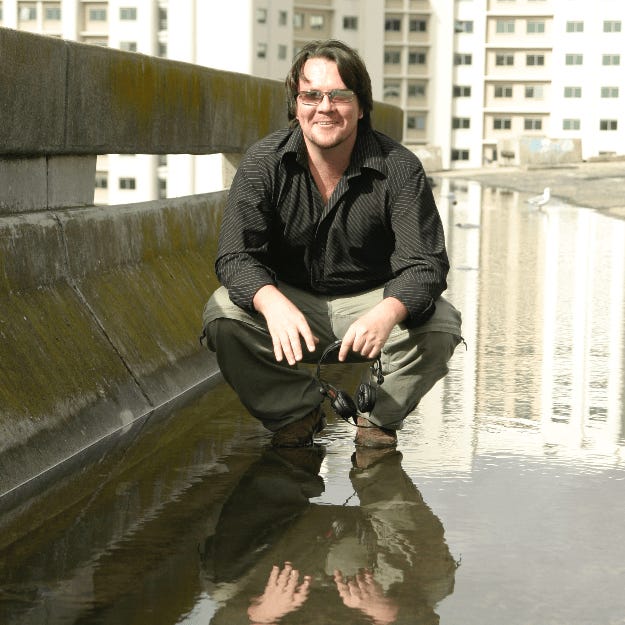
Eric McCallaghan's accomplishments speak for themselves, with his music being recognized around the world. His single "Xplicit" (under his Heatseeker alias) was #1 in South Africa for several months in 1999 and received the Best South African Dance Track award. It is released worldwide on more than 30 compilations. "Reflections" received a South African Music Award Nomination in 2003. "Touch Faith" is an official Depeche Mode remix of Personal Jesus, and was #1 in Belgium, with 8 weeks on the sales charts and Ultratop 40 2007. "Woven" was #29 on the world DMC Trance Charts in 2008. Paul Oakenfold played "I'll Wait For You" at a 911 benefit concert in New York in 2001. John '00' Flemming gave "Spinning" 4 ½ out of 5 in Mixmag 1998. Eric McCallaghan has also DJed in Pakistan, Belgium, Holland, the UK, and at Miami WMC 2011
1. You signed to BMG Records Africa in 1996 and moved between remixes, originals and international compilations early on. How did that period shape your idea of success and your approach to production did industry opportunities change the way you wrote, arranged or marketed music?
2. As the founder of Beats Me Records - with an enormous physical output (CDs, vinyl and compilations) you’ve lived through the era of print media into the streaming age. What did running an independent label teach you about curating music and audiences, and how has your relationship to physical formats (CDs, 12”) changed the way you release or package art today?
3. You’ve had standout international moments - “Xplicit” topping South African charts, a Depeche Mode remix reaching Belgium’s charts, Paul Oakenfold playing your track in New York - how have those milestones influenced your artistic priorities? Did they push you toward new sounds, bigger stages, or more toward composing for film/TV and licensing?
Eric’s History
“As a keyboardist for a number of bands incl Communique, State of Mind and Girl2Boys since 1989, i got into production, sequencing and composing at an early age. My goal was to get a decent record deal, and after doing a keyboard only original set at Pulp Rave Carlton Center December 1995, i took the recording on DAT to BMG Africa, as i met Nancy Hillary when Eddie Kramer did a workshop at Downtown Studios. A lot of work went into that 10 track demo and I believe the quality secured my signing as that was the time Faithless, Robert Miles and so many others started molding the sound of dance for the late 90s. My first release was a remix of Ultravox Vienna on CD single, recorded at Downtown, Pulp party creator Lance Longley engineering. 4 mixes and an original “Sex On Mars” . The launch was in Rosebank, dancers, vocalist Jacqui and a few keyboards. Nobody has seen this in SA on that level before. Friends I made that night are still friends today. BMG’s dance division was managed by Spiro Damaskinos - ex UK dj and a very inspiring aura. You asked about the period. That’s when it started. Vienna sold maybe a 1000 CD singles. Not bad for an unknown, but not good for motivation.
My next original Everybody House was put on a compilation album, and that sold 10 000. So, me and Spiro produced a dance track for Trance House 1, which Spiro compiled. We called ourself Heatseeker.
We put a track on Serious Beats 1. Other labels noticed and RPM (Gallo dance label) asked me if they can use one of my originals on their new CD single series. I gave them What The Funk, they called me Wanton, and BMG agreed that I can produce under pseudonyms.
Derek the Bandit got hold of me. Sheer Dance. What’s Hot in DTB Box followed, Floating for Zoe, Madube, Earth 2000. Sasha and lanF, Always in my Dreams. Mark Gilman, Love it in the Morning. Meanwhile Trance House 2 featured LightSeeker. On 3 we went back to Heatseeker. 4 had Xplicit on it - the Blade track. More compilation albums.
Bellisima single went gold. I went to London in 1997, planned 2 weeks to look for a record deal. Took me 6 hours. Then the 12” vinyl started getting released world wide. 1st one, Spinning was on John 00 Flemming’s playlist. Xplicit on Judge Jules. I’ll Wait for You Paul Oakenfold. 1998 started flying to Europe 3 times a year doing shows in Holland, Belgium and UK.
Xplicit went to number 1 SA dance charts. By 2001 I moved to London. Camden Palace Peach on Friday nights with Graham Gold and Richard Coal. Played Karachi Pakistan. At this point we on Trance House 8 and Serious Beats 4, I have 20 12” all over the world, and about a million CDs sold from 20 singles, 3 albums and 100 compilations.
Every production was following trends and styles. Trance mostly. But also Patricia Lewis, Naked, Mauritz Lots, Sugardrive, DJ Mike ESP, Lady Lea, DJ Scotty, Nelson. World Hold On remix, Baby Elephant Walk, Rocky Horror Picture Show, Mickey Mozart, Jani, Riaan van Rensburg, Plofstof.
2003 album Everytime this Song Plays had co-writes with Nick E Lauder. Lindsay McGuire, Tamsin McCarthy, Fernando, Spiro. Sonnique played the title track in her sets. And it had Touch Faith - official Depeche Mode Personal Jesus remix. Faith Music Belgium released it on 12” and it went to number one on Ultratop40 Belgium based on sales.
And then it stopped. No more BMG, no more CDs, no more vinyl, no more touring. 2005. Bad. 2006 and 2007 played Belgium and Holland, but no new releases. It didn’t work for me so i got a girlfriend...finally.
Since then i have released more than a 100 songs on Spotify, 125 on YouTube, and I made a hundred bucks!
What was the question again?
The Future - byME
Recently I developed and created byME. It is a web and mobile platform enabling artists, musicians, producers and djs to sell music at live shows direct to their fans via mobile proximity detection.
An artist uploads his music, creates EPs and Albums at a certain price (or free for promo), and at a show or event the fans detects this list, copies it to their phone, get the free music including up to 90min mixes, buys what they want - and then carries this list to sell on whenever somebody detects them. I patented proximity detection and resale of digital files via mobile phones by interaction with fellow superfans.
byME manages all transactions, allow users to withdraw profits, you can sell merchandise at shows or via delivery, unlimited uploads and show creation. You can create a show in Australia and send your music to your friend’s lounge via gps coordinates.
As a label you can manage your artists music and money. The artist always gets 30%, the seller and label 10% each. The artist is the only one who can sell his music at a show for a set duration, meaning he gets 50% if he’s a label. Afterwards the fans can sell everything they are carrying and collect music by having fun.
Artists should upload music that’s not on Spotify or whatever- unique versions, demos, their 1st live performance, versions that didnt get put on albums, acoustic sets, dj sets. byME is not a record label. It is a Musica or a Look and Listen (music stores - ed).
The social page connects you to fellow fans, buy and sell 2nd hand gear, meet musicians, stick a sticky to a Marshall amp to let everyone know about your new video on YouTube. Sell merchandise or anything you want. Payment handled by byME, sales and statistics managed on site.
The tutorial videos should be up by the time this is printed, but I can do demos if you send me a message. Go to http://byme.today “
ESSAY FEATURE - More Than the DJ Booth: On the Collective Labour of the Night
It is easy to talk about nights as if they begin and end with the DJ. The lights go down, the booth lights up, and something happens between the person behind the decks and the people on the floor. That story is neat, legible, and flattering. It is also incomplete.
A night out is not a transaction between performer and audience, it is a temporary ecosystem assembled, maintained, and dismantled by many people whose work is designed, almost deliberately, to disappear. When a night works, it feels seamless. When it does not, we suddenly notice everything that had been kept in motion.
That seamlessness is an effect of labour. Before anyone hears a kick drum, decisions have already been made about money, timing, risk, and relationships. Promoters and organisers operate in that pre-moment, stitching together logistics, permissions, timetables and compromises. They hold the long view of the night, absorbing stress so others do not have to feel it.
At the door another kind of work begins. Door staff are often framed as obstacles or enforcers, but their job is closer to social moderation. They read bodies, energy, intoxication and intention. They decide when to say no, when to make exceptions, when to intervene and when to protect. Those choices shape who feels safe inside, who feels welcome and who does not. This is emotional and physical labour, performed under pressure and rarely acknowledged once the music starts.
Inside the room bar staff keep the night moving in quieter ways. They manage pace, mood and micro-interactions, they offer small kindnesses, set firm boundaries and serve quickly without escalating chaos. They are often the first to notice when someone is unwell, overwhelmed or alone. Like much service work, this labour blends the practical with the emotional, and it is typically visible only when it falters.
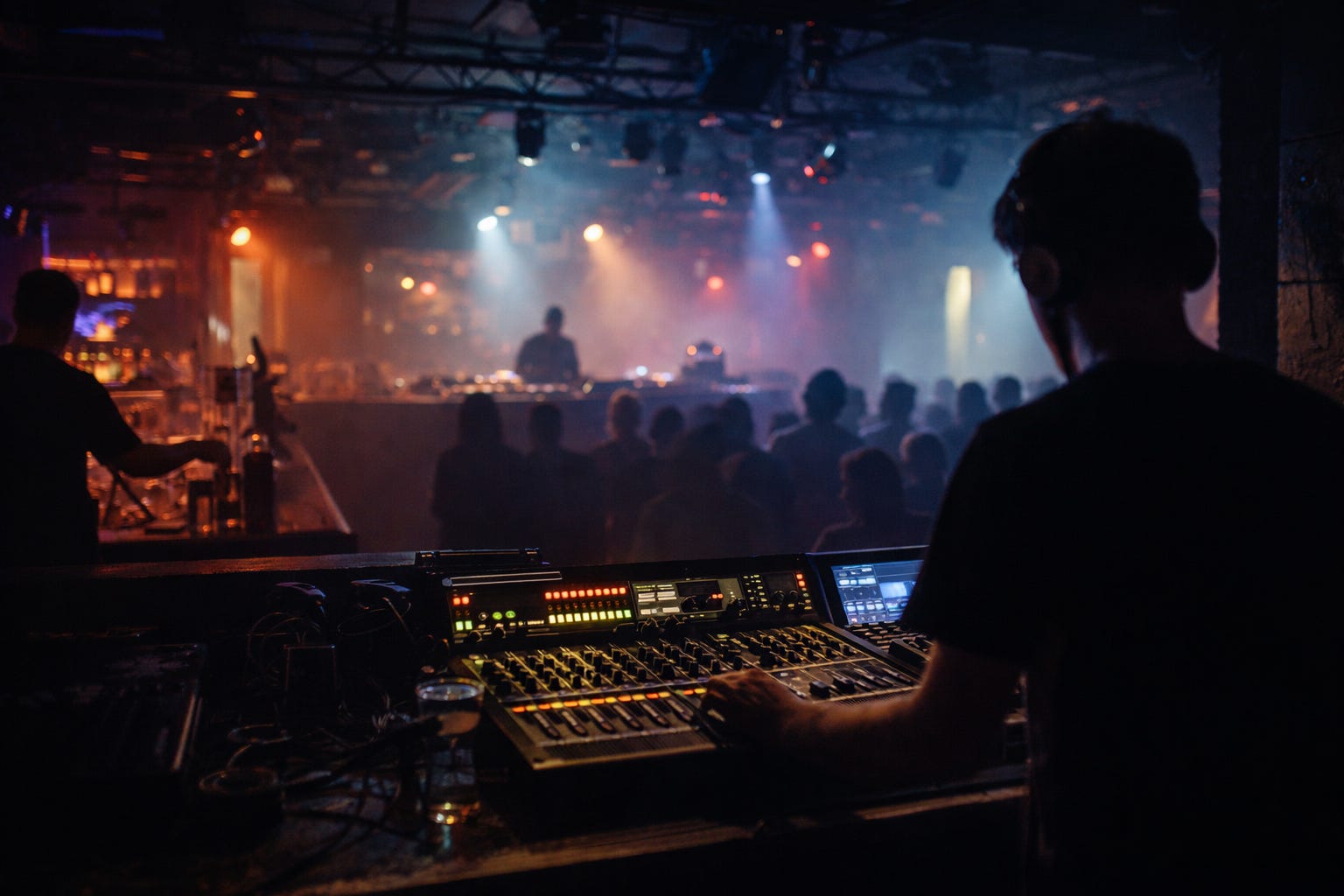
Sound and lighting technicians co-author the experience even if their names never appear on a flyer. The way bass travels through a room, the clarity of a vocal, the moment a light opens or retreats, these choices shape how music is felt not just heard. A skilled technician adapts constantly to a room filling, to equipment failing, to a DJ pushing things further than planned. Their work is interpretive, responsive and deeply tied to the character of the night.
There is another, upstream hand in this system, the producer in the studio whose track arrives in a DJ set as if by magic. That record began as someone’s late-night project, a conversation with gear, a test send to friends, a white-label or a promo dropped into a private pool. Sometimes producers make music explicitly with the floor in mind, sometimes the dance floor discovers their work after the fact, but in either case production is another form of labour that feeds the night. It is often invisible, precarious and undervalued, and it deserves recognition as part of the same ecology that makes a night possible.
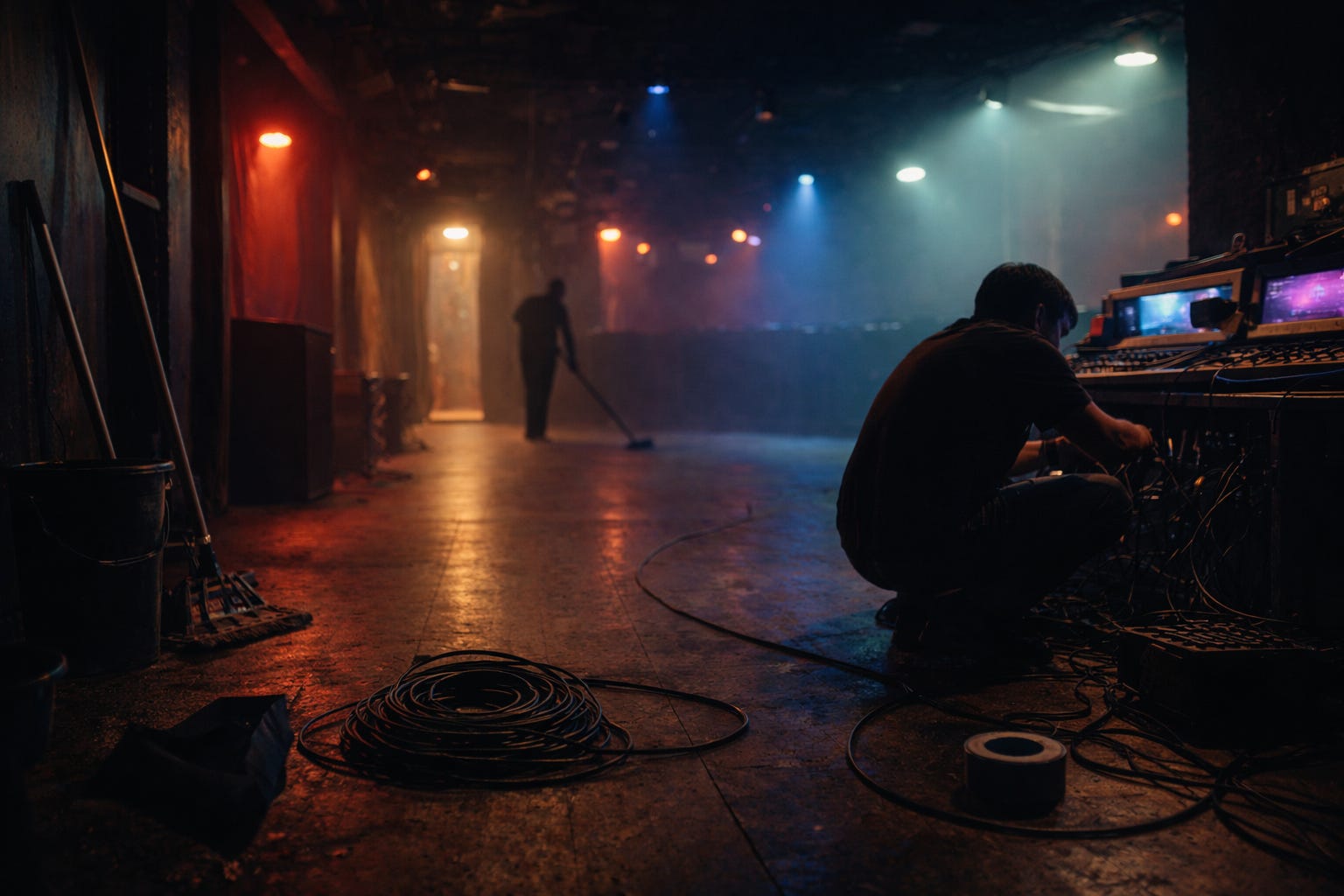
And then there are the people who make repetition possible. Cleaners, maintenance workers and closing staff arrive when the night is technically over, restoring the space so it can host another gathering. Their labour exists outside the mythology of nightlife, but without it there is no next weekend, no sustained scene. That it happens after the lights come up does not make it secondary, only easier to ignore.
What links all of these roles is interdependence. No single part of the night stands alone. The DJ relies on the sound system, which relies on the technician, which relies on the venue, which relies on the cleaner, which relies on the organiser, which relies on the door staff, which relies on trust built over time. The hierarchy we often imagine, with the DJ at the top, collapses when we look closely at how nights actually function.
Visibility and value are unevenly distributed. Cultural narratives, media coverage and scene memory tend to spotlight those already most visible. This shapes how labour is rewarded, how burnout accumulates and whose work is considered essential versus optional. Invisibility is not neutral, it has material consequences.
DJs themselves often move between these roles over time. Many have worked doors, cleaned venues, carried speakers, run cables and mediated conflicts long before or alongside playing publicly. Understanding the night as collective labour does not diminish the act of DJing, it situates it within a wider system of care and effort. It replaces the myth of individual authorship with something closer to reality.
Seen this way, nightlife is not primarily a product to be consumed, it is a practice that is rehearsed, repaired and repeated. Each night is an agreement, fragile and temporary, to hold space together. Music is the reason people gather, labour is what allows them to stay.
When we start to notice this, small things change. Gratitude shifts direction. Accountability becomes collective rather than individual. Histories get written differently. We become more careful about what we celebrate and more attentive to what we take for granted.
The room itself becomes the focus again, not the booth, not the brand, not the moment captured on a phone, but the shared space briefly held together by many hands. Music happens there not in spite of labour, but because of it.
- SD.
Signal Dept. chronicles culture that refuses commodification. Field reports and scene intel: theswingcafe@gmail.com
Find Signal Dept on Bluesky and YouTube
Art is a relationship, not a product. Let’s build the systems it deserves.
[END OF SIGNAL DEPT. — Edition 16]